From Traditional SEO to AI Search: 14 Months of Growing Flawless Cleaning’s Organic Visibility
How an evolving, long-term SEO strategy increased page-one Google rankings by 663% – while organic traffic remained resilient through one of the biggest periods of change search has seen in years.
The Results at a Glance
May 2025 → July 2026
- 📈 31 → 100 ranking keywords – +223%
- 🥇 8 → 61 page-one rankings – +663%
- 🏆 0 → 11 top-three rankings
- 👑 0 → 3 number-one rankings
- 🚀 18 → 81 page-one and page-two rankings – +350%
- 📊 26.03 → 13.37 average ranking position – an improvement of 12.66 positions
And perhaps most importantly, Flawless Cleaning isn’t simply ranking for more keywords.
It’s increasingly ranking for the commercial searches that matter to the business.
The Client
Flawless Cleaning is a Norwich-based cleaning company providing commercial and specialist cleaning services across Norwich and Norfolk.
My conversations with owner Ruth began in October 2024, before Flawless Cleaning eventually became an ongoing Mae Day Marketing SEO client in May 2025.
Ruth had worked with an SEO agency previously but was looking for something different – a more strategic, transparent approach where recommendations could be understood, discussed and adapted around the needs of the business.
The objectives were broader than simply ‘get higher on Google’.
Flawless wanted to:
- Increase local brand awareness
- Generate more business leads
- Continue growing within Norwich
- Expand further into new areas of Norfolk
- Attract a mixture of commercial contracts
- Improve the overall optimisation and effectiveness of the website
That meant rankings mattered – but which searches Flawless appeared for mattered even more.
“Judi-mae / Mae Day Marketing has done a huge amount for Flawless over the last year and I’m genuinely very grateful for everything she’s done for us.”
Ruth, Flawless Cleaning
Where We Started
When the ongoing SEO work began in May 2025, Flawless Cleaning’s website ranked for 31 keywords within the report.
Only 8 were on page one of Google.
There were no top-three rankings and no number-one positions.
The average position of keywords with a numerical ranking was 26.03.
There was already a foundation to work with, but there was considerable opportunity to improve how clearly the website communicated Flawless Cleaning’s services, geographical relevance and increasingly important commercial focus.
So that’s where I started.
“SEO strategy isn’t about doing everything you possibly can. Particularly for SMEs, it’s about identifying what will make the biggest difference within the time and budget available, measuring what happens, and deciding what deserves attention next.”
Judi-mae Alderton, Mae Day Marketing
Phase One: Strengthening the SEO Foundations
The first few months concentrated heavily on the fundamentals.
I reviewed and made recommendations across core pages including the homepage, About, Commercial Cleaning, Carpet & Hard Floor Cleaning, Upholstery Cleaning and Deep Cleaning.
The work included:
- Monthly blogs
- Internal linking
- Calls to action
- H1 and H2 structure
- Existing website copy
- New supporting content
- Keyword research and mapping
- Page titles and meta descriptions
- Local Norwich and Norfolk relevance
- Image filenames, alt text and compression
The first blog, for example, was ‘What Sets Flawless Apart from Other Cleaning Companies in Norwich?’. The following month we tackled ‘What Does Commercial Cleaning Actually Involve?’, followed by content around out-of-hours cleaning and the different industries Flawless Cleaning supports.
But this was never intended to be a one-off SEO ‘fix’.
Each month, I reviewed what was happening and used that information – alongside changes within the business itself and the wider search landscape – to decide where attention should go next.
From More Rankings to the Right Rankings
By July 2026, the difference was substantial.
- Flawless Cleaning was ranking for 100 keywords, compared with 31 at the beginning – an increase of 223%.
- Page-one rankings had increased from 8 to 61 – up 663%.
- There were now 11 top-three rankings, compared with none at the beginning, including three number-one Google positions.
But raw keyword numbers only tell part of the story.
Some of the strongest positions were now:
#1 – commercial cleaners Norfolk
#1 – office cleaning Norwich
#2 – office cleaners Norwich
#2 – office cleaning Norfolk
#3 – commercial cleaners Norwich
#3 – commercial cleaning Norwich
#4 – commercial cleaning Norfolk
Those searches closely reflect the kind of commercial work Flawless wants to attract and the geographical areas in which the business originally wanted to grow. That’s much more meaningful than simply reporting that ‘traffic is green’ or that another 20 keywords have appeared somewhere in Google.
My thoughts:
“Rankings still matter, but I’ve become much more interested in what a business is ranking for and whether that visibility matches the work it actually wants. Losing visibility for an irrelevant domestic term isn’t necessarily bad news if commercial visibility is strengthening at the same time.”
We’ve actually seen examples of that during the work carried out for Flawless Cleaning.
As the business increasingly prioritised commercial cleaning, some domestic cleaning terms declined. Rather than automatically treating every downward movement as bad news, I looked at those movements in the context of the client’s actual business objectives.
SEO metrics need interpretation, not just reporting.
And importantly, the impact hasn’t just been visible in the rankings. Ruth has noticed a difference in the enquiries Flawless Cleaning receives, too.
“We have definitely noticed an improvement in the enquiries coming through the website since starting the SEO work.”
She also reports receiving more relevant commercial and deep-cleaning enquiries, with domestic enquiries now rare.
“I feel like the website is working much harder for us now than it did previously.”
Ruth, Flawless Cleaning
Then Search Started Changing – Fast
All of this happened during an extraordinary period for organic search. AI-generated search results became substantially more prominent, changing not only where websites appear but whether users need to visit them at all.
A Pew Research Center analysis of browsing behaviour found that users clicked a traditional Google search result in only 8% of visits where an AI summary appeared, compared with 15% where one didn’t. Only 1% of visits resulted in a click on a source cited within the AI summary itself.
The picture has become even more striking as AI Overviews have developed.
In February 2026, Ahrefs published updated research using 300,000 keywords. It found that the presence of an AI Overview correlated with a 58% lower average click-through rate for the number-one ranking page. Its earlier 2025 research had estimated the reduction at 34.5%.
In other words, ranking highly is still hugely valuable – but a high ranking no longer guarantees the same click behaviour it once did.
That meant our strategy couldn’t stand still either – and it hasn’t.
SEO in Month 14 Shouldn’t Look Like SEO in Month One
As the campaign developed, my recommendations increasingly moved beyond straightforward keyword optimisation.
We worked on areas including:
- Search intent
- Expertise and trust
- Author information
- Supporting resources
- More useful calls to action
- Industry-specific information
- FAQs and question-led content
- Business values and differentiation
- Commercial relevance and use cases
- Content relationships and internal linking
- Content designed around genuine customer questions and decisions
For example, by spring 2026 recommendations included refining the intent of the Deep Cleaning page, adding explicit commercial use cases to Upholstery Cleaning, strengthening the ongoing contract-cleaning message and clarifying the types of businesses Flawless Cleaning is best suited to work with. By July, recommendations included organising blog content into categories, creating ‘Related Reading’ relationships and adding author information to articles.
The blogs themselves evolved too.
Rather than producing endless variations of ‘Commercial Cleaning Norwich’ content, topics increasingly answered specific questions potential customers might genuinely have:
- ‘How Often Should Offices Be Professionally Cleaned?’
- ‘What Happens If You Don’t Have a Regular Office Cleaning Schedule?’
- ‘How to Deal With Common Office Stains (Without Making Them Worse)’
- ‘Why Office Chairs Need Professional Cleaning More Often Than You Think’
- ‘How to Choose a Commercial Cleaning Company in Norfolk (And Why Values Matter)’
The ‘How to’ office stains article, for example, doesn’t simply promote cleaning services. It gives practical advice about coffee, grease, mud, ink and upholstery before explaining when professional intervention makes sense and connecting readers with relevant specialist services.
That’s useful content for humans.
And increasingly, clarity, context, expertise and genuinely useful answers are also important when content is being discovered and interpreted through AI-powered search experiences. As I explained to another client currently onboarding Mae Day Marketing for SEO support:
“The biggest mistake would have been treating SEO in month 14 exactly as I treated it in month one. Search changed during the campaign, particularly as AI became a much bigger part of how people discover and evaluate businesses. The strategy had to change with it.”
Visibility Increased Dramatically – Organic Traffic Remained Resilient.
This is perhaps the part of the story I find most interesting.
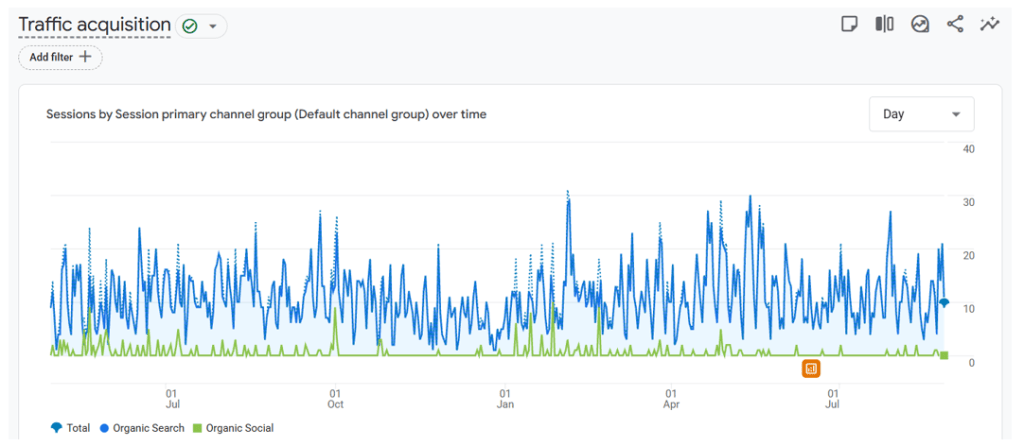
Across the period reviewed, Flawless Cleaning’s organic search traffic has remained broadly resilient, with the latter part of the period appearing somewhat stronger overall.
It’s worth putting that stability into the context of what’s happening across organic search more widely.
Research published by Search Engine Land in October 2026, using Similarweb data covering thousands of websites in the US and France, found that organic search visits had declined by 13.2% and 24.4% respectively over the preceding two years. More than 60% of the websites analysed in both countries had experienced a decline.
Further research published in November 2026 examined Google Search Console data from 110 websites across six industries. It found that almost three in four homepages (74%) had experienced a decline in organic clicks, with a median reduction of 21% when comparing Q3 2026 with Q3 2025.
Neither study establishes that AI alone caused these declines, and the second specifically examines homepage clicks rather than overall website traffic. Nevertheless, together they illustrate the wider challenges facing organic search, as AI-generated answers and changing search behaviour reshape how people discover and visit websites.
I wouldn’t claim that SEO alone caused every movement in that graph, nor can I prove precisely how much traffic Flawless would have received in a world without AI Overviews.
That’s not how responsible marketing analysis works.
But put the two things together:
- Organic visibility increased dramatically
- Organic traffic remained resilient
And that happened during a period in which independent research suggests AI-generated search results have been substantially reducing clicks through to websites.
Have we definitively bucked the AI traffic trend?
I can’t prove that.
But we may well have done! 😉
And at the very least, the results demonstrate why I believe modern SEO has to focus on considerably more than simply getting a website to appear somewhere on page one.
A Long-Term SEO Relationship That Has Changed With the Business
There’s another part of this case study that matters to me, particularly because of the way I like to work with clients.
The scope of my relationship with Flawless Cleaning hasn’t remained identical for 14 months.
- Budgets change
- Priorities change
- Businesses change
- Search certainly changes
Of course they do – so the work has flexed in line with these things too.
Some months have concentrated on existing website pages. Others have focused more heavily on content, site structure, commercial positioning, internal links, technical housekeeping or identifying larger opportunities for future development.
Not every recommendation gets implemented immediately either – that’s normal.
My job as a consultant is to keep looking at the business, the data and the marketing landscape and advise what I believe should happen next.
Because I personally deliver the work for my clients, that knowledge doesn’t disappear when a project moves from one department or account manager to another.
I know what we were trying to achieve ✅
I know when the original approach needs to evolve ✅
I know why something was changed six months or a year ago ✅
“What a business needs from me in year two isn’t necessarily what it needed on day one. I do the work myself, so I can retain that knowledge, see what’s changing and adapt the strategy around what the client needs, wants and can afford at that point in time.”
That principle extends well beyond SEO.
Some Mae Day Marketing clients originally came to me years ago for a new website and now return when they need a new service added, functionality changed, a section rebuilt or simply another pair of experienced marketing eyes on what comes next.
I like working that way.
Long-term marketing support shouldn’t mean selling somebody exactly the same thing forever.
That continuity is something Ruth has particularly valued, having previously worked with an SEO agency.
“With previous SEO support, it could sometimes feel like you were just one client amongst many and you didn’t always really know what was being done or why. Working with you has felt much more personal and transparent.”
Ruth, Flawless Cleaning
She also highlighted the importance of understanding Flawless Cleaning’s services, target customers and longer-term ambitions, rather than treating SEO as an isolated activity.
The Results After 14 Months
So, returning to the numbers:
| SEO visibility | May 2025 | July 2026 | Change |
| Ranking keywords | 31 | 100 | +223% |
| Page-one rankings | 8 | 61 | +663% |
| Top-three rankings | 0 | 11 | 0 → 11 |
| Number-one rankings | 0 | 3 | 0 → 3 |
| Page 1 + 2 rankings | 18 | 81 | +350% |
| Average ranking position* | 26.03 | 13.37 | 12.66 positions better |
*Average calculated across keywords with a numerical ranking in each reporting period.
I’m very proud of those numbers. And hearing from Ruth that the website is now attracting more of the right enquiries makes them even more meaningful.
But I’m even happier that the strongest rankings increasingly correspond with Flawless Cleaning’s commercial ambitions in Norwich and Norfolk.
That’s the difference between optimising a website to generate impressive-looking reports and optimising it around the business behind it.
In the Client’s Own Words
Of course, rankings and performance data are only part of the picture. What matters just as much is how the client feels about the work, the results and the relationship.
And I’m delighted that Ruth’s experience reflects what I’ve been working to achieve.
“I would absolutely recommend working with Mae Day Marketing. Judi-mae is approachable, knowledgeable and genuinely invested in the businesses she works with. SEO can be one of those things that feels quite confusing when it isn’t your area of expertise, but you explain things clearly and make the whole process feel much easier. I’ve always felt that I can ask questions and get an honest answer.”
Ruth, Flawless Cleaning
What 14 Months of SEO Has Reinforced for Me
SEO certainly is not dead – but SEO is absolutely changing.
The search results people see, the way they formulate questions, the information Google gives them before they click and the increasing role of AI in discovering businesses all mean that optimisation has to evolve.
- Rankings still matter
- Keywords still matter
- Technical foundations still matter
But so do intent, authority, clarity, relevance, expertise, brand, useful content and giving search engines and AI systems enough context to understand who you are, what you do, who you help and why you’re credible.
Flawless Cleaning’s results show what can happen when SEO is treated as an ongoing marketing strategy rather than a checklist of tasks.
Fourteen months.
31 → 100 ranking keywords.
8 → 61 page-one rankings.
0 → 11 top-three rankings.
And some exceptionally strong commercial search positions in exactly the geographical market the client originally wanted to grow.
And, according to the client herself, that visibility is translating into more relevant enquiries for the services Flawless actually wants to provide.
That’s what makes these results especially satisfying. Not simply more rankings, but a website doing a better job of supporting the business behind it.
I’ll take that 👑
Need Long-Term Marketing Support That Can Evolve With Your Business?
I work directly with businesses as an experienced marketing consultant, providing flexible support that can change as your priorities do.
That might begin with SEO. It might begin with a new website, content, strategy or something completely different.
The important bit is that you’re working with me.
No outsourcing, no agency account-manager merry-go-round, definitely no rigid package that assumes your business will need exactly the same thing next year as it does today.
Just practical, experienced marketing support that can grow, shrink and change with you.
Talk to Mae Day Marketing today about ongoing marketing and SEO support.

Mae Day Marketing
Multiple Award Winning Marketing Consultancy, based in Norfolk, UK.
Get in Touch
We would love to hear from you!
📞 07828 852448